
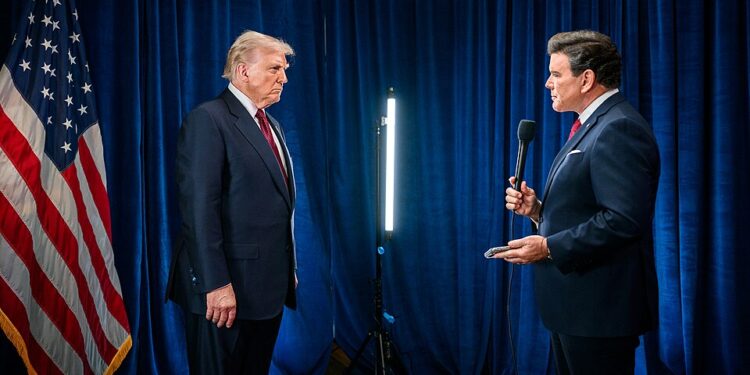
President Donald Trump forcefully rejected a question from Bret Baier about whether he had underestimated Iran’s ability to withstand months of military pressure, delivering a response that reassured supporters who believe America must project strength abroad.
During an interview recorded in Beijing and set to air on Special Report with Bret Baier, Baier asked Trump if Iran had shown more endurance than expected and pressed him for a timeline on when the conflict might come to an end.
Trump made it clear he does not believe the United States miscalculated.
“I didn’t underestimate anything,” the president said. “We hit them unbelievably hard.”
Trump Says the United States Still Holds Overwhelming Power
Trump explained that U.S. forces intentionally avoided destroying key Iranian infrastructure, including bridges, electrical systems, and oil facilities. According to the president, those targets remain available if Iran refuses to back down.
“We can knock that all out in two days,” Trump said. “Everything.”
The president also noted that he chose not to fully disable Iran’s oil export network, preserving economic leverage while keeping pressure on Tehran.
For conservative Americans, this strategy reflects Trump’s long-standing approach to foreign policy: use decisive force, maintain strategic options, and avoid unnecessary destruction when leverage can achieve better results.
Bret Baier Asks the Question Millions of Americans Are Asking
Baier then shifted to the issue weighing heavily on voters across the country.
“Americans want to know when it’s over though, right?” he asked.
The question comes as many families are concerned about rising energy prices, instability in the Middle East, and the possibility of a prolonged conflict.
Trump responded by reminding viewers that some of America’s most difficult wars lasted for many years, including the Vietnam War, the Korean War, and the Iraq War.
“We’re in there for two and a half months,” Trump said, emphasizing that the current operation remains relatively short by historical standards.
Trump Highlights the Human Cost of War
The president also spoke about the sacrifice made by American service members and their families.
“I wish we’d lost none,” Trump said. “I know those parents. I spoke to them.”
The comment underscored Trump’s effort to combine military resolve with a personal awareness of the cost of conflict.
Rising Oil Production Offers Economic Relief
Trump pointed to a surge in domestic energy activity as a positive sign for the American economy. He said oil tankers were heading to Texas, Louisiana, and Alaska to load U.S. oil supplies.
That development could help offset market disruptions and reinforce one of Trump’s signature priorities: restoring American energy dominance.
For retirees and working families alike, lower energy costs remain a major issue, making domestic oil production a key part of the administration’s message.
Polls Show Americans Want Stability
Recent polling suggests the public is divided over how the conflict is being handled, with many Americans hoping for a swift resolution that protects U.S. interests while avoiding a wider war.
At the same time, many conservatives continue to support Trump’s belief that strong leadership and credible military power are essential to deterring hostile regimes.
Why Trump’s Response Resonated With Supporters
To millions of Americans, especially older voters who have lived through decades of foreign conflicts, Trump’s answer conveyed confidence and control.
Rather than conceding that Iran had outlasted U.S. expectations, the president argued that America still possesses overwhelming military and economic leverage.
His message was straightforward: the United States remains in command, and Iran understands that the most powerful tools have not yet been fully used.
The Bottom Line
Bret Baier’s question reflected growing public concern about the length of the Iran conflict, but Trump’s response sent a different message.
The president insists he did not underestimate Iran, that the United States retains decisive military options, and that his administration is committed to protecting American interests from a position of unmistakable strength.
For supporters who value peace through strength, the interview served as another reminder of Trump’s belief that resolve—not retreat—is the surest path to stability.