
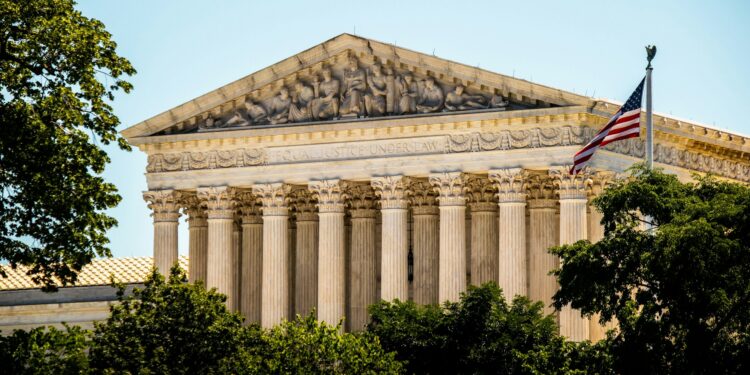
The U.S. Supreme Court is preparing to hear a closely watched case involving veterans’ disability benefits, constitutional rights, and the ability of former service members to challenge federal law in court.
The case, Johnson v. United States Congress, could determine whether veterans who believe a federal benefits law violates the Constitution may file a lawsuit or whether they must first go through the Department of Veterans Affairs’ specialized review process.
While the dispute began with one Florida veteran, the Supreme Court’s eventual ruling could have consequences for veterans across the country.
At issue is a basic legal question: When a veteran believes Congress passed an unconstitutional benefits law, where should that challenge be heard?
Supreme Court Takes Up Major Veterans Benefits Dispute
The case involves Floyd D. Johnson, a former U.S. Army infantryman who served between 1983 and 1985.
Johnson was later convicted of multiple state felony offenses in Florida in 2013 and sentenced to 40 years in prison.
During his time in prison, he was diagnosed with service-related PTSD and subsequently sought disability benefits from the Department of Veterans Affairs.
Johnson initially received a 70 percent disability rating. That rating was later increased to 80 percent.
However, federal law limits the amount of VA disability compensation certain incarcerated veterans may receive after they have been imprisoned for more than 2 months.
Because of that provision, Johnson’s payments were reduced to the amount associated with a 10 percent disability rating.
Johnson argues that the federal statute authorizing that reduction violates the Constitution.
That argument has now reached the Supreme Court.
Why Johnson Challenged the Veterans Benefits Law
Johnson did not simply argue that the Department of Veterans Affairs incorrectly calculated his benefits.
Instead, he challenged the legality of the federal statute itself.
He filed a lawsuit in federal district court arguing that the law restricting disability compensation for incarcerated veterans was unconstitutional.
The district court dismissed his lawsuit in 2022.
In August 2025, the 11th U.S. Circuit Court of Appeals also rejected his arguments.
The appeals court noted, among other things, that Johnson had brought his lawsuit against Congress rather than the Department of Veterans Affairs.
The court also pointed to the specialized review process Congress created for veterans’ benefits disputes.
Under that system, veterans generally challenge VA decisions through administrative appeals before potentially taking their cases to the U.S. Court of Appeals for Veterans Claims and then the U.S. Court of Appeals for the Federal Circuit.
Johnson argues that constitutional challenges should be treated differently.
Can Veterans Go Directly to Federal Court?
That question is now at the center of the Supreme Court case.
Johnson’s lawyers argue that veterans should be allowed to bring certain constitutional challenges directly before a federal district judge.
The federal government argues that Congress created a specific review system for veterans’ benefits disputes and that claimants should follow that process.
The outcome could determine how veterans challenge federal laws affecting disability compensation, pensions, and other benefits.
If Johnson prevails, veterans could potentially have a more direct route to federal court when they claim that Congress itself enacted an unconstitutional law.
If the government prevails, veterans may be required to continue using the VA’s administrative and specialized judicial review system before reaching broader federal courts.
A 1974 Supreme Court Case Could Be Crucial
Johnson’s argument relies heavily on a Supreme Court ruling issued more than 50 years ago.
In the 1974 case Johnson v. Robison, the Supreme Court examined whether limits on reviewing veterans’ benefits rulings barred federal courts from considering constitutional claims.
The justices ruled 8-1 that the law at issue did not prevent federal courts from reviewing certain constitutional claims.
Johnson argues that Congress never clearly eliminated that protection when lawmakers later passed the Veterans’ Judicial Review Act in 1988.
That law established a more formal system for reviewing VA benefits decisions.
The Supreme Court must now decide how the older precedent fits with the newer review structure.
Veterans Advocates Say Constitutional Rights Are at Stake
Several veterans’ advocacy groups have supported Johnson’s position.
Their argument is that Congress intended to expand judicial review for veterans when it adopted the Veterans’ Judicial Review Act—not prevent veterans from challenging federal statutes on constitutional grounds.
Alison Weir, who leads the Connecticut Veterans Legal Center and previously served in the U.S. Air Force, told Newsweek that the case centers on whether veterans can directly contest federal laws they believe are unconstitutional.
Military-Veterans Advocacy has also backed Johnson.
In a legal brief filed with the Supreme Court, the organization argued that the Veterans’ Judicial Review Act was intended to increase opportunities for judicial review rather than restrict them.
That distinction could become important for veterans who believe the problem is not simply a VA decision but the underlying federal law itself.
Government Defends Existing VA Review Process
The federal government has urged the Supreme Court to preserve the established veterans’ benefits review system.
Government attorneys argue that Congress created a comprehensive process for resolving disputes involving VA benefits.
Under that system, veterans can challenge decisions administratively before moving into specialized federal courts.
Supporters of the government’s position say this structure helps produce consistent decisions and allows judges with experience in veterans’ law to review claims.
The government also argues that veterans already have a legal path for challenging benefits decisions.
The dispute is therefore not about whether veterans can seek judicial review at all.
Instead, it is about which court gets to hear certain constitutional claims and at what point in the process.
Why the Supreme Court Agreed to Hear the Case
Johnson asked the Supreme Court to review his case in December 2025.
The justices agreed to hear it in April 2026.
The Supreme Court generally does not explain why it accepts a particular appeal.
However, legal experts have pointed to disagreement among lower courts over whether the Veterans’ Judicial Review Act prevents veterans from taking constitutional challenges directly to federal district court.
Kristin E. Hickman, a professor at the University of Minnesota Law School, told Newsweek that lower courts have divided over how the law should be interpreted.
That disagreement increases the importance of a Supreme Court ruling.
A decision from the justices could create a single nationwide standard.
What a Johnson Victory Could Mean for Veterans
If the Supreme Court sides with Johnson, veterans could gain a clearer path to federal district court when they challenge the constitutionality of a federal benefits law.
That would not necessarily allow veterans to bypass the VA whenever they disagree with a disability rating or benefits decision.
Routine disputes over eligibility, disability percentages, payment amounts, or administrative decisions could still remain within the traditional VA appeals system.
The major change would involve cases where veterans argue that the law passed by Congress is itself unconstitutional.
For some veterans, that distinction could make it easier to have major constitutional questions considered by a federal judge.
The ruling could also influence future cases involving veterans’ disability benefits, compensation restrictions, and federal benefits law.
What Happens If the Federal Government Wins?
If the Supreme Court sides with the government, the existing review structure would likely remain firmly in place.
Veterans raising constitutional objections connected to their benefits could be required to begin within the VA system and proceed through specialized appeals.
Critics of that approach say veterans could face a longer and more complicated legal process.
Supporters say the system provides consistency and ensures that veterans’ benefits cases are first considered by agencies and judges familiar with the complicated rules governing VA compensation.
Either way, the Supreme Court’s decision could clarify a legal question that has created disagreement among lower courts.
Why This Case Matters to Veterans and Their Families
Millions of veterans and their families depend on federal benefits programs for financial security, health care, disability compensation, and other forms of support.
That makes the legal process surrounding those benefits especially important.
The Johnson case does not ask the Supreme Court to decide whether all incarcerated veterans should receive their full disability compensation.
Instead, the justices are addressing a narrower question involving access to federal courts.
The answer could determine how veterans challenge federal laws they believe violate constitutional protections.
For veterans who have spent years navigating the VA system, the ruling could also clarify where certain legal disputes belong.
Supreme Court Decision Could Set Nationwide Veterans Benefits Precedent
The Supreme Court is set to hear oral arguments Monday, with a ruling anticipated later in its 2026-2027 term.
The ruling could establish an important precedent governing the relationship between veterans, Congress, the Department of Veterans Affairs, and the federal courts.
If Johnson wins, veterans could receive a clearer avenue for bringing certain constitutional challenges directly before federal judges.
If the government wins, the VA’s specialized review system could remain the primary path for nearly all benefits-related disputes.
Either outcome could have lasting implications for veterans’ rights and the way federal benefits laws are challenged in the United States.
For veterans and their families, this is one Supreme Court case worth watching closely.