
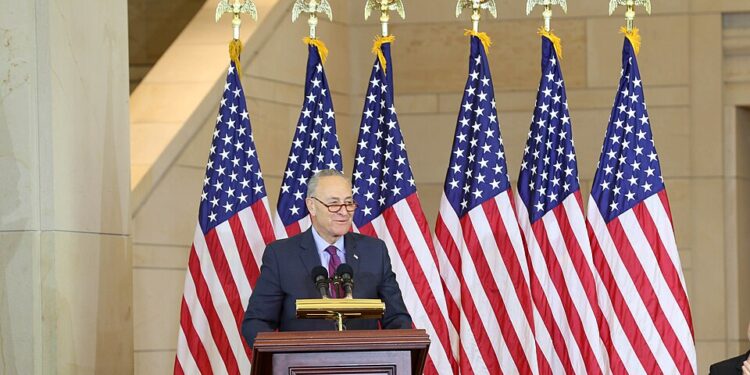
Senate Democratic Leader Chuck Schumer is facing one of the biggest political challenges of his career, and the growing rebellion within his own party could threaten his nearly decade-long hold on Democratic leadership.
Maryland Democratic Sen. Chris Van Hollen is openly campaigning to replace Schumer, claiming he has growing support among Senate Democrats and accusing the New York senator’s allies of attempting to discourage lawmakers from backing his challenge.
The dispute comes at a particularly sensitive moment for Democrats, who are preparing to take control of the Senate following their victories in the November 2026 midterm elections.
Instead of celebrating a united front, the party now faces an increasingly public leadership battle that could determine its direction for years to come.
With a crucial vote approaching, Schumer’s political future is suddenly facing serious questions.
Van Hollen Says Schumer’s Leadership Is Vulnerable
During a Sunday appearance on ABC’s “This Week,” Van Hollen expressed confidence about his chances of replacing Schumer as the next Senate Democratic leader.
The Maryland senator revealed that approximately 15 senators are supporting his campaign, claiming that number continues to increase.
He also challenged the perception that Schumer has already secured enough votes to remain in power.
Van Hollen accused members of Schumer’s political operation of spreading misleading information about the leadership contest.
According to Van Hollen, some lawmakers identified as Schumer supporters have privately committed to backing his campaign instead.
He further alleged that Schumer’s allies are attempting to pressure senators into supporting the incumbent leader.
Those accusations have intensified what was already shaping up to be an unusually contentious leadership election.
Schumer, however, has publicly maintained that he has sufficient support to win another term as Democratic leader.
The competing claims mean the outcome remains uncertain until senators formally cast their ballots.
Democrats Face Growing Divisions Following Midterm Elections
The internal Democratic battle is unfolding just days after the November 3 midterm elections, when voters handed Democrats control of both chambers of Congress.
Those victories could have strengthened Schumer’s position as the party prepares to confront President Donald Trump’s administration during the remaining two years of his presidency.
Instead, some Democrats are arguing that electoral success does not necessarily mean voters are satisfied with the party’s current leadership.
Van Hollen believes Democrats must demonstrate that they understand the economic concerns driving voter frustration.
He has emphasized rising living costs, economic inequality and the influence of powerful financial interests in Washington.
The Maryland senator argues that Democrats should focus on delivering results rather than returning to familiar political routines.
His leadership challenge reflects a wider disagreement within the party over how aggressively Democratic lawmakers should confront Republicans and how they should approach their legislative priorities.
For Republican lawmakers, the dispute also raises questions about how effectively Democrats will be able to govern once they assume control of the Senate in January.
Schumer’s Longtime Leadership Comes Under Pressure
Schumer has been the top Senate Democrat since 2017, succeeding former Democratic Leader Harry Reid.
Over that period, he has played a central role in major congressional negotiations involving federal spending, judicial confirmations and legislation affecting millions of Americans.
His leadership has also attracted criticism from progressive activists who believe he has sometimes been too willing to compromise with Republicans.
One major source of frustration emerged in 2025, when Schumer supported advancing a Republican-backed government funding measure.
Critics argued that the decision weakened Democrats’ leverage against the Trump administration.
Schumer defended his approach, but the controversy contributed to broader dissatisfaction among some members of his party.
That frustration has continued despite the Democratic Party’s recent electoral victories.
Van Hollen’s candidacy now gives lawmakers who want a different approach an opportunity to challenge the established leadership.
The contest has attracted support from prominent progressive figures, including Vermont independent Sen. Bernie Sanders, who caucuses with Democrats.
However, several influential senators remain firmly behind Schumer, citing his experience and the party’s success in the midterms.
The disagreement has created a significant test of loyalty within the Democratic caucus.
A Major Disagreement Over Washington’s Direction
One of the biggest questions surrounding the leadership contest is whether Senate Democrats should pursue major changes to the way Congress operates.
That includes the Senate filibuster, a procedural mechanism that generally requires 60 votes to advance most legislation.
Van Hollen has expressed support for eventually changing the filibuster, although he has said eliminating it would not be an immediate priority.
Instead, he believes Democratic senators should discuss possible reforms before making major procedural decisions.
The issue could have lasting consequences for both political parties.
The filibuster has historically provided the minority party with leverage over legislation involving federal spending, immigration, election policy and other controversial issues.
Changing the rule could make it easier for a Senate majority to advance its legislative agenda without bipartisan support.
For Republicans, the debate is especially significant because Democrats will soon control the chamber.
Any major procedural changes could influence how effectively President Trump’s remaining priorities can move through Congress.
At the same time, Van Hollen has rejected suggestions that his campaign is primarily about pushing Democrats toward more progressive policies.
He insists that his focus is on restoring public confidence and responding to economic concerns.
Schumer’s Allies Push Back Against Leadership Challenge
Despite the increasingly public campaign against him, Schumer is not stepping aside.
The longtime Democratic leader has insisted that he possesses the votes necessary to retain his position.
His supporters argue that Democrats’ midterm victories provide a strong reason to maintain experienced leadership rather than pursue a potentially divisive transition.
Several lawmakers have publicly expressed confidence in Schumer’s ability to guide the party through the next Congress.
Those endorsements could prove important because the leadership election will be conducted by secret ballot.
That process allows Democratic senators to make their decisions without publicly revealing their preferences.
Van Hollen, meanwhile, maintains that Schumer’s support is not nearly as secure as his allies suggest.
The Maryland senator has also criticized reported efforts to move the leadership election to an earlier date.
He argues that Democrats should have sufficient time to evaluate both candidates and debate the party’s future.
The disagreement over the election schedule has added another layer of tension to an already competitive contest.
December 1 Vote Could Change Senate Democratic Leadership
The leadership election is scheduled for December 1, 2026, making the coming weeks particularly important for both candidates.
Van Hollen must persuade enough Democratic senators to abandon Schumer and support a change at the top.
Schumer must demonstrate that his longstanding relationships and recent electoral success are enough to preserve his leadership position.
Neither side can declare victory before the votes are counted.
While Van Hollen says he has approximately 15 supporters, that number alone would not be enough to secure the leadership position.
He would need to win a majority of the Democratic caucus.
Schumer’s public confidence suggests that the incumbent believes he has the advantage, but the secret-ballot process leaves room for surprises.
The contest also carries implications beyond the Democratic Party.
Whoever wins will play a major role in shaping the Senate’s legislative priorities, negotiating with congressional Republicans and determining the chamber’s response to the Trump administration.
What Schumer’s Leadership Battle Means For Washington
The confrontation between Schumer and Van Hollen illustrates how quickly political circumstances can change, even after a successful election.
For years, Schumer’s leadership position appeared largely secure.
Now, his future is being openly debated by members of his own party.
Van Hollen sees an opportunity to reshape Democratic leadership and present voters with a different approach to governing.
Schumer believes his experience and track record make him the strongest choice to lead Democrats into their new Senate majority.
The decision ultimately belongs to Democratic senators, who must determine whether continuity or change offers the better path forward.
For President Trump and congressional Republicans, the result could influence future negotiations over federal spending, immigration enforcement, economic policy and other major national issues.
Regardless of which Democrat emerges victorious, the leadership battle has already exposed disagreements over the party’s priorities and political strategy.
Schumer has not been removed from leadership, but his position is now facing a formal challenge with a decisive vote approaching.
On December 1, Senate Democrats will decide whether the longtime New York leader remains in charge or whether a new generation of leadership takes his place.