
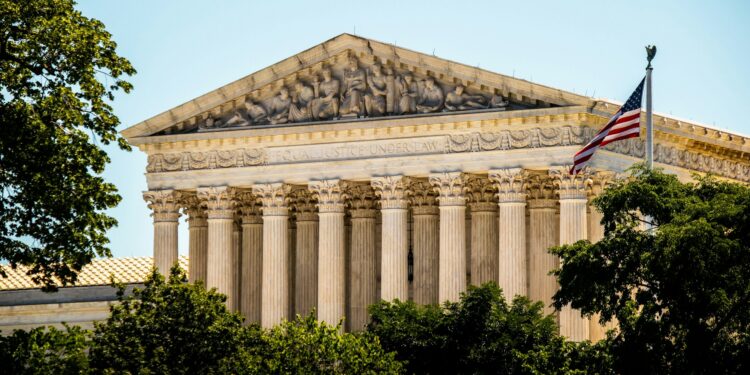
A major Supreme Court ruling tied to Donald Trump has ignited a political firestorm—one that could dramatically reshape the balance of power in Congress ahead of the next election.
Lawmakers in Washington are now scrambling after the Court struck down several race-based congressional districts, ruling they violate the Constitution. The decision immediately triggered fierce reactions on both sides—and could open the door to a major Republican advantage in the House.
Democrats quickly sounded the alarm, claiming the ruling weakens protections under the Voting Rights Act and could reduce minority representation. Some even compared the outcome to setbacks not seen since the civil rights era, warning it could shift political power in key states.
But Republicans see something very different: a long-overdue correction.
GOP leaders praised the decision as a victory for fairness, arguing that congressional maps should not be drawn based on race. Instead, they say districts should reflect voters—not political engineering.
Sen. Tommy Tuberville wasted no time calling for action, urging Alabama lawmakers to redraw their congressional map immediately. He pointed to the state’s overwhelming support for Trump and argued its representation in Washington should match that reality.
Currently, Alabama has two Democrat-held majority-minority districts. Tuberville made it clear that changing those lines could be a game-changer.
“In a country where only a handful of House seats decide everything, even two more Republicans could make the difference,” he argued.
That message is spreading fast.
Sen. Marsha Blackburn is pushing for similar changes in Tennessee, calling for a special session to redraw districts and strengthen Republican control. She framed the effort as critical to advancing Trump’s agenda and preserving what she called America’s “Golden Age.”
Meanwhile, Sen. Jim Banks described the situation bluntly: an escalating political “arms race.”
“If one side redraws maps, the other side will too,” Banks said, predicting a nationwide battle over district lines.
That battle has already begun.
In Florida, lawmakers moved within hours of the ruling to approve a new congressional map that could hand Republicans several additional seats. Analysts say similar efforts could soon unfold in states like Missouri, Louisiana, and South Carolina.
Sen. Josh Hawley emphasized that states now have a clear directive from the Court: race cannot be the driving factor in drawing districts unless absolutely necessary.
The ruling itself came from a Louisiana case, where the Court struck down a second majority-Black district. Writing for the majority, Justice Samuel Alito said the Constitution rarely allows government decisions based on race—and Louisiana failed to justify its approach.
The liberal wing of the Court strongly disagreed.
Justice Elena Kagan warned the decision could make it far harder to challenge unfair maps and protect minority voting power.
Democratic senators, including Cory Booker and Raphael Warnock, echoed those concerns, calling the ruling deeply troubling for election fairness.
Still, both parties have already been aggressively redrawing maps where they hold power—turning congressional districts into one of the most important battlegrounds in modern politics.
And with so few competitive seats left nationwide, even small changes could have massive consequences.
Bottom line:
This Supreme Court decision didn’t just settle a legal question—it launched a nationwide political fight that could determine who controls Congress next.