
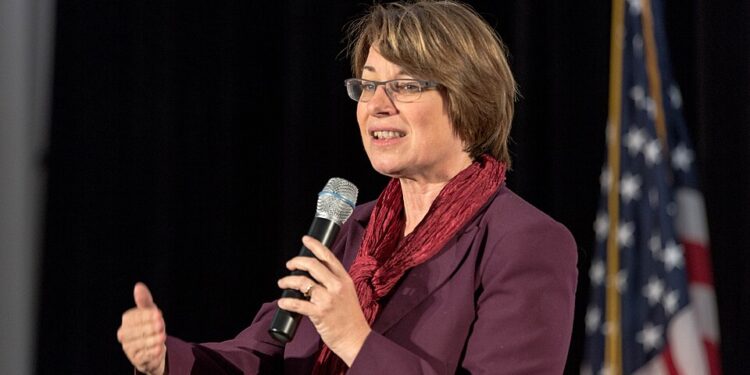
Minnesota’s newly elected Democratic governor is already facing fierce opposition from gun rights advocates after announcing plans to make sweeping firearms restrictions a top priority of her incoming administration.
Governor-elect Amy Klobuchar, who defeated Republican Lisa Demuth in the November election, has made it clear that she wants lawmakers to approve legislation targeting certain semiautomatic firearms and ammunition magazines.
Her announcement has sparked criticism from the National Rifle Association (NRA) and other Second Amendment supporters, who warn that the proposed measures could place significant new restrictions on law-abiding gun owners.
The controversy is shaping up to become one of the first major political battles of Klobuchar’s governorship, even before she officially takes office in January 2027.
New Democrat Pushes for Major Gun Restrictions
During her first press conference following the November 3 election, Klobuchar identified gun control legislation as one of the issues she wants Minnesota lawmakers to address.
The governor-elect expressed confidence that a comprehensive firearms bill would eventually become law.
Her comments focused on legislation similar to Senate File 4067, a sweeping proposal that narrowly passed the Minnesota Senate earlier this year.
The measure received support from 34 senators and opposition from 33, demonstrating just how divided state lawmakers remain over the issue.
However, the legislation never received a final vote in the Minnesota House of Representatives.
Klobuchar acknowledged that some provisions could change during future negotiations but indicated that she wants the central elements of the proposal preserved.
That position immediately raised concerns among gun owners who believe additional regulations could threaten their constitutional rights.
What Would the Proposed Gun Control Law Do?
The legislation contains several provisions that could significantly change Minnesota’s firearms regulations.
Among the most controversial is a proposal restricting sales of certain semiautomatic firearms, including AR-15-style rifles.
The bill would also restrict ammunition magazines capable of holding more than 17 rounds.
Those provisions are particularly significant because semiautomatic rifles are legally owned by Americans for sporting activities, recreational shooting, and home defense.
However, the legislation goes beyond restricting future sales.
Under the proposal, individuals who already legally own covered firearms or magazines would generally be permitted to keep them, but they would face additional state certification requirements.
Owners would have to obtain certification through Minnesota’s Bureau of Criminal Apprehension and renew that certification every three years.
Failing to comply could carry serious legal consequences.
Knowingly possessing a covered firearm or magazine without the required certification could result in a gross misdemeanor charge, while subsequent violations could lead to felony penalties.
The bill also includes provisions addressing unserialized firearms, binary triggers, firearm storage, school safety, and mental health funding.
Supporters describe these measures as necessary public safety protections.
Critics argue that some of the restrictions would impose unnecessary burdens on responsible firearm owners without adequately addressing criminal violence.
Importantly, these proposed restrictions have not become law. Any new legislation would need to complete the legislative process before taking effect.
NRA Responds to Klobuchar’s Announcement
Klobuchar’s remarks quickly drew criticism from the National Rifle Association, one of the country’s most prominent Second Amendment advocacy organizations.
The NRA accused the incoming governor of pursuing additional restrictions on lawful firearm ownership under the justification of improving public safety.
The organization has indicated that it intends to oppose the legislation and could challenge new restrictions in court if they become law.
The Minnesota Gun Owners Caucus has also warned that the election results could make it easier for Democratic lawmakers to advance firearms legislation previously blocked in the state legislature.
For gun rights advocates, the concern extends beyond the proposed restrictions themselves.
They argue that requirements involving government certification, periodic renewals, and potential criminal penalties could establish additional barriers to exercising a constitutionally protected right.
The backlash highlights an ongoing national disagreement over whether stricter gun laws can reduce violence without unfairly affecting lawful firearm owners.
Second Amendment Rights Could Become a Major Legal Issue
The debate surrounding Minnesota’s proposed firearms legislation could eventually extend beyond the state Capitol.
The Second Amendment guarantees the right of Americans to keep and bear arms, and the U.S. Supreme Court has repeatedly addressed the scope of those protections.
In its landmark 2008 decision in District of Columbia v. Heller, the Court recognized an individual’s constitutional right to possess firearms for lawful purposes, including self-defense.
The Supreme Court further addressed gun rights in its 2022 decision in New York State Rifle & Pistol Association v. Bruen, establishing a framework requiring firearm regulations to be evaluated in light of America’s historical tradition of firearm regulation.
Those decisions continue to influence legal challenges involving state and federal firearms restrictions.
However, courts have not resolved every constitutional question involving semiautomatic rifles, magazine capacity limits, or firearm registration requirements.
If Minnesota adopts legislation resembling Senate File 4067, opponents could challenge its provisions in court.
Such litigation could potentially become part of the broader national debate over the constitutional limits of gun control.
Minnesota Republicans Face a New Political Challenge
The controversy also places Minnesota Republicans in a difficult position following Klobuchar’s election victory.
The incoming governor defeated Republican House Speaker Lisa Demuth, who had opposed advancing the firearms proposal during the previous legislative session.
Demuth and other Republicans had helped prevent the legislation from reaching a final House vote.
Now, with Democrats positioned to control the governor’s office and both legislative chambers, supporters of additional gun regulations may have a stronger opportunity to advance their agenda.
That changing political landscape has concerned gun owners who previously relied on Republican lawmakers to block legislation they considered overly restrictive.
For rural residents, hunters, recreational shooters, and individuals who keep firearms for personal protection, the debate could have practical consequences.
New certification requirements or restrictions on covered firearms could affect how residents purchase, transfer, and maintain certain legally owned weapons.
The precise impact will depend on the language of any legislation lawmakers ultimately approve.
Gun Control Debate Comes Amid Other State Concerns
The firearms controversy arrives as Minnesota’s incoming administration prepares to confront several other pressing challenges.
Klobuchar campaigned on improving government accountability, addressing fraud, and reducing financial pressures on families.
Her victory followed considerable public attention surrounding fraud investigations involving state-administered programs.
The governor-elect has promised to strengthen oversight and restore public trust in government.
She has also emphasized housing affordability, education, and economic concerns.
Republican critics have questioned whether pursuing controversial gun restrictions should be among the administration’s earliest priorities.
Supporters of the firearms legislation, meanwhile, argue that protecting public safety is an important responsibility of state government.
The proposal gained momentum following the deadly 2025 shooting at Annunciation Catholic School in Minneapolis, which intensified demands for additional gun safety measures.
The disagreement illustrates the competing priorities Klobuchar will face as she attempts to govern a politically divided state.
What Happens Next for Minnesota Gun Owners?
The next major developments will occur when Minnesota lawmakers return for the 2027 legislative session.
Although Senate File 4067 passed one legislative chamber in 2026, it did not become law. Any renewed effort would require lawmakers to introduce and approve legislation during the new session.
Klobuchar has expressed confidence that a gun safety proposal will pass, but the exact provisions of a future bill have not been finalized.
Lawmakers could modify the restrictions, negotiate exemptions, or introduce alternative measures.
Gun rights groups are expected to closely monitor the legislative process and oppose provisions they believe infringe on constitutional protections.
For now, Minnesota firearm owners are not required to comply with the new certification system proposed in Senate File 4067.
That could change if lawmakers approve similar legislation in the coming months.
The larger question is whether Minnesota’s new Democratic leadership can advance stricter firearms regulations while addressing the constitutional concerns raised by Second Amendment advocates.
With Klobuchar preparing to take office and gun rights organizations already promising resistance, Minnesota appears headed toward a significant political confrontation over firearm ownership.
The outcome could influence not only state gun laws but also the broader national conversation about constitutional rights, public safety, and government regulation.