
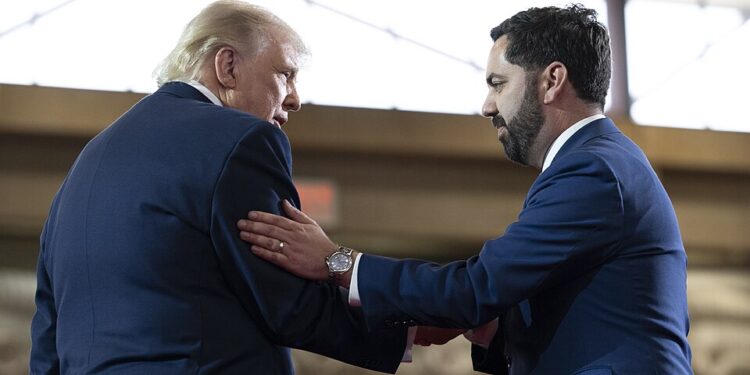
President Donald Trump is pushing Republicans to unite behind his agenda ahead of the November midterm elections, but one GOP congressman in a closely watched race is making it clear that supporting the party does not mean agreeing with the president on everything.
Rep. Mike Lawler of New York publicly emphasized his independence from Trump on Sunday, saying his first responsibility is to the voters who sent him to Washington.
“I pledge my allegiance to my constituents, which I always have,” Lawler said during an appearance on ABC’s “This Week.”
The comment came just days after Trump addressed Republicans at the party’s midterm convention in Dallas and asked attendees to raise their right hands and pledge that they would vote in November.
For Lawler, however, the issue goes beyond a convention pledge. The New York Republican is also raising questions about Trump’s newly announced proposal to provide $5,000 payments to American adults if Republicans maintain control of Congress.
Lawler Makes His Position Clear
Lawler represents New York’s 17th Congressional District and is seeking reelection against Democrat Cait Conley, an Army combat veteran.
His district supported former Vice President Kamala Harris over Trump in the 2024 presidential election, putting Lawler in the position of representing voters with sharply different political views.
That political landscape has made Lawler’s relationship with Trump particularly noteworthy.
While campaigning, Lawler has stressed his support for Republican priorities while also maintaining that he is willing to disagree with the president.
“The truth is that the president and I don’t always agree,” Lawler told Republicans at the Dallas convention. “And that’s OK.”
His comments underscore a challenge facing Republicans representing politically competitive districts: how to maintain support among the GOP base while also appealing to independents and voters who may not support Trump.
Trump’s $5,000 Dividend Faces Questions
Lawler’s independence became even clearer when he was questioned about Trump’s proposed $5,000 dividend.
Trump announced the proposal at the Republican convention, saying every adult U.S. citizen would receive $5,000 if Republicans retain control of both the House and Senate following the midterm elections.
The president has argued that America’s economic strength would allow the federal government to afford the payments.
Lawler stopped short of endorsing the plan.
“I support putting money back in the pockets of hardworking Americans,” he said.
But the congressman quickly turned his attention to the enormous potential cost.
“Whether you call it a stimulus check or a dividend, the question is, how do you pay for it?” Lawler said. “That’s my focus. We have a $4 trillion deficit, and we have to be serious about tackling that.”
That puts Lawler at odds with Trump on at least one major question surrounding the proposal: whether Washington can comfortably afford it.
The Price Tag Could Reach $1.2 Trillion
Trump’s proposed payments would represent one of the largest direct-payment programs in American history.
With approximately 240 million American adults potentially eligible, distributing $5,000 to each of them would cost roughly $1.2 trillion.
Trump and Vice President JD Vance have pointed to tariff revenue as a possible source of money. However, current tariff collections are far below the amount necessary to finance the entire proposal.
There is another important hurdle as well.
Trump could not simply order the Treasury Department to distribute the money on his own. Congress controls federal spending, meaning lawmakers would have to authorize the payments before Americans could receive them.
House Speaker Mike Johnson acknowledged that reality Sunday, saying lawmakers would need to work through the details.
That could set up a major debate in Washington over taxes, government spending, inflation and the federal deficit if Republicans attempt to move forward with the proposal.
Republicans Aren’t Completely United
Lawler is not the only Republican raising questions about Trump’s idea.
The proposal has received support from some GOP lawmakers, but other Republicans have expressed concerns about its price tag and potential economic consequences.
Those concerns center largely on whether another massive round of federal payments could increase government borrowing or add inflationary pressure to an economy where the cost of living remains an important concern for many households.
Similar questions emerged following the stimulus payments distributed during the COVID-19 pandemic.
Congress approved three rounds of direct payments during 2020 and 2021, ultimately distributing hundreds of billions of dollars to Americans.
Trump’s latest proposal would be even larger.
Democrats Attack Trump’s Proposal
Democrats have also criticized the plan, although for different reasons.
Some Democratic lawmakers have questioned whether Trump could actually deliver the payments, while others have accused the president of using the promise as an election-year political strategy.
The debate is likely to intensify because Trump explicitly tied the proposed dividend to Republicans maintaining control of Congress.
Trump has argued that Republican victories would allow his administration to continue its economic agenda and make the payments possible.
Critics argue that major federal spending decisions should not depend on the outcome of an election.
Ultimately, however, Congress would have to approve the money regardless of which party controls Washington.
Lawler Walks A Political Tightrope
For Lawler, the disagreement comes at a sensitive moment.
Republicans are fighting to preserve their House majority, and competitive districts such as his could play an important role in determining which party controls the chamber after November.
Lawler therefore has political incentives to demonstrate independence while still supporting major elements of the Republican agenda.
His comments Sunday appear designed to reinforce that distinction.
Rather than rejecting the idea of returning money to taxpayers, Lawler focused his criticism on the financial details and the growing federal deficit.
That allows him to support the broader goal of helping American families while demanding an explanation for how Washington would pay for such an enormous program.
A Bigger Debate Over Spending
The disagreement between Trump and Lawler also highlights a larger debate taking place inside the Republican Party.
For years, Republicans have campaigned on reducing federal spending, controlling deficits and limiting Washington’s debt.
Trump’s proposed $5,000 dividend presents lawmakers with a difficult question: whether putting a substantial amount of money directly into Americans’ pockets is worth the potential impact on federal finances.
Supporters may argue that Americans deserve to benefit directly from stronger government revenues and economic growth.
Skeptics are likely to focus on the cost, the deficit and the possibility that Washington would ultimately have to borrow much of the money.
Lawler has clearly signaled which question he wants answered first.
How will the government pay for it?
What Happens Next
Trump continues to promote the $5,000 dividend and said Sunday that the United States could “easily” afford the payments.
But turning the proposal into reality would require lawmakers to approve the necessary spending.
That means Lawler and other members of Congress could eventually be forced to take an actual vote on the president’s plan.
Until then, Lawler appears determined to maintain some distance from Trump when the two disagree.
His message is straightforward: he is a Republican, but his ultimate responsibility is to the people of New York’s 17th Congressional District.
With control of the House at stake in November, that distinction could receive considerably more attention as Election Day approaches.